Your team has a hidden curriculum.
The hidden curriculum hides behind both the choices you make and don’t make as the leader. It hides under your team rituals. It hides within the felt knowledge of whose voice matters on the team, and whose voice doesn’t. When team members don’t feel respected within their team’s hidden curriculum, they’ve likely got one foot out the door, considering other opportunities.
Here, I want to encourage you to be intentional about your team’s hidden curriculum. To make it not hidden. And to tell you about one practice that’s done more for my team in this area than almost anything else I’ve tried.
Hidden Curriculum
In educational fields, "hidden curriculum" refers to what students learn implicitly in school. There's the explicit curriculum: the subject matter, the learning goals. And then there's the hidden curriculum: the values and norms that make up the context wherein a student learns.
Each classroom has a hidden curriculum, whether it's acknowledged or not. The same is true of professional teams, although we might think more in terms of "team culture." Each team has a team culture, which carries with it a hidden curriculum; acknowledged or not, it's there. The team feels it (either as motivating or demotivating). The work reflects it.
Back when I was studying education, our professors encouraged us to deeply consider our own biases, our own beliefs and circumstances, and how these might affect the hidden curriculums of our future classrooms. They guided us in how to craft the hidden curriculums of our classrooms intentionally, in other words, how to unhide hiddenness in order to create environments where people felt respected and safe to be themselves. The idea being that in spaces where we feel respected, we do our best work. And we want to be there.
I've taken this same approach in building up the design team here at Fetchly. And I now understand why my professors spent so much time on it, why it's so important to be intentional about crafting and recrafting hidden curriculum. Especially on teams where many people working together have different backgrounds from one another, like the many teams within Fetchly. Here it requires more effort, not less. It requires not ignoring what makes us distinct, but bringing our uniquenesses into light together and listening to one another.
As a note, part of the work of shaping team culture is about establishing and respecting work rules and boundaries. Naturally we don't need to share everything about ourselves in order to feel comfortable; we feel comfortable when what we do share is received with respect.
The Share
It's worth the time to try out a variety of team rituals. And to keep changing it up. Don't just settle for a weekly retro because you've always done it that way. We cut our retro because it had gone stale. I didn't want staleness to be what we relate over. Instead, experiment. Dig for resources. There's a lot out there. Here’s a list of human-invented icebreakers from The Art of Noticing that I rocked for a couple years of meetings, got us smiling. Whatever you do, don't settle for the work being all that matters, or your team's work will reflect that low bar.
All that said, I could talk about a number of rituals that have done a lot for my team's curriculum. For brevity though, I'll highlight just one.
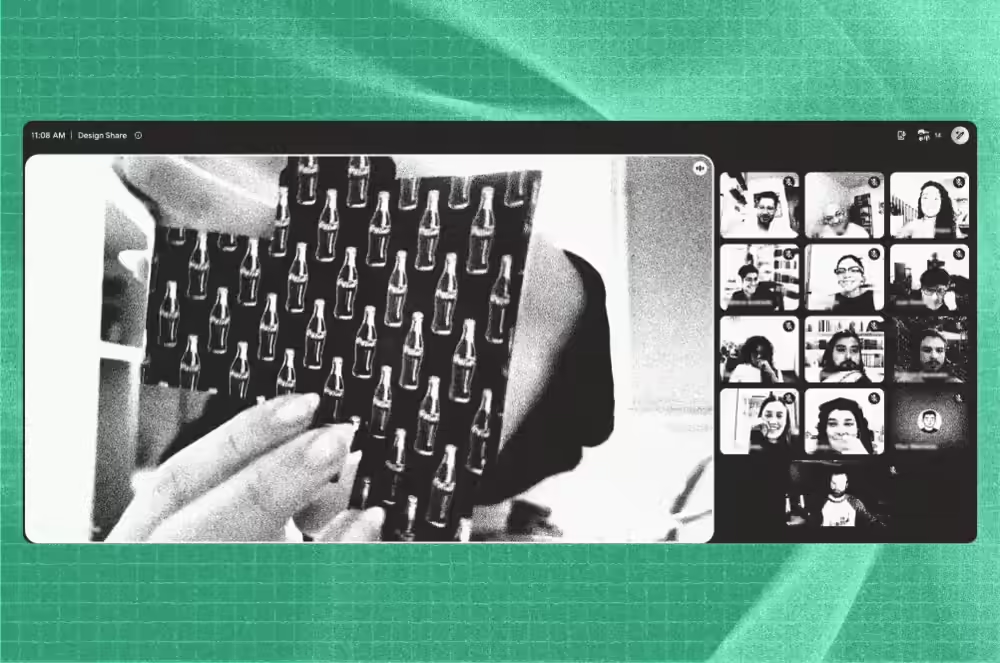
The Share is a half hour long, full team, weekly meeting, where one person shares… anything.
Whatever they want (again, within work rules, which by the way we've landed on, "No religion, No politics"). Someone shares whatever they want for a half hour. That’s it. Super simple. They might give a presentation, show a video, hold a discussion, hold your undivided attention as they rate every household item they ever purchased using their own complicated rubric. Who knows?! It's glorious.
I'm gonna go ahead and list some of the Shares we've had over the last couple years. Give you a taster. While these examples might express the personalities of my team, the point here is range. Space. Freedom for your team to be themselves.
Some of my team’s Shares:
- I Miss Old Internet
- Discovering Electronic Music
- Live piano performance
- The Paintings of José Pancetti
- A collective rating of the foods of Festa Junina
- My Trash Journal (see blog cover image)
- Top 10 Conspiracy Theories
- My Favorite Color
What's Changed
I’ve been running the Share weekly for almost two years now. My team is not the same (literally, we’ve almost tripled). When new team members join the team, they ramp into our culture more quickly now, seeing that while our work might suggest we belong to a superior species we are indeed strangely human.
When your team is allowed to be strangely human, even fallible, they stop performing competence and start sharpening one another. Vulnerability becomes a bridge to collaboration and skilling up.
Strengths become more visible too, in a way that’s reliable. This opens opportunities for pairings, workshops, specialization, leadership. Yesterday, a designer on my team put together an impressive marketing campaign proposal, which we shared with our marketing agency directly. She’s a designer, not a marketer, but she has a marketing background.
It helps to know your people.
It helps for hard conversations, for performance reviews, even easy conversations! Sometimes what makes a conversation hard is simply not knowing who you're talking to.
The Share is one ritual. It won't be the right one for every team, and it's not the only thing shaping my team's curriculum. It's just the one I can easily point to and say: here, this is what happens when you stop leaving it to chance.
Your hidden curriculum is there. Shape it.